
Aloe Vera Care Guide
Aloe vera
Also called True aloe, Medicinal aloe, Barbados aloe
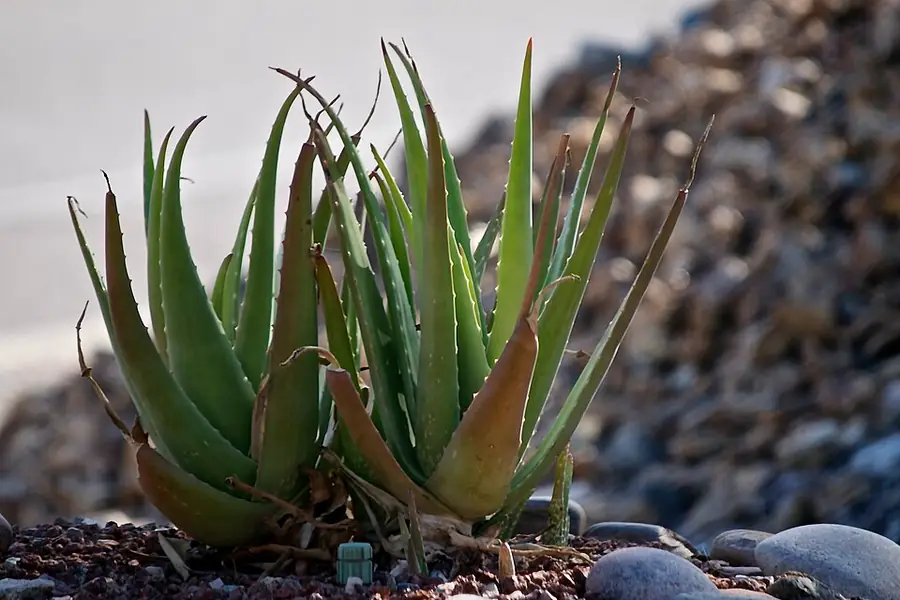
Photo Dorian Wallender from Lake Havasu City, Arizona, USA · CC BY-SA 2.0 via Wikimedia Commons
- Family
- Asphodelaceae
- Native to
- Arabian Peninsula; cultivated worldwide for millennia
- Mature size
- 1-2 ft tall and wide
- Toxicity
- The latex layer just beneath the leaf skin contains anthraquinones that cause vomiting and diarrhoea in cats and dogs. The clear inner gel is not the toxic part.
Aloe Vera care at a glance
Light
Bright, 6+ hours direct sun
The sunniest windowsill you have, meaning a south or west exposure. Aloe grown in low light stretches, flattens and flops outward.
How to measure light at homeWater
Every 2-4 weeks
Soak thoroughly, then let the soil dry completely before watering again. In winter, once every 5-6 weeks is plenty.
How to water houseplants properlyHumidity
Low, under 40% is fine
A desert succulent. High humidity plus poor airflow encourages rot and fungal spots.
Temperature
55-85°F (13-29°C)
Protect from frost. Aloe can summer outdoors but must come in before temperatures drop below 50°F (10°C).
Soil
Gritty cactus and succulent mix
Cactus mix with extra perlite, pumice or coarse sand. Standard potting soil holds far too much water.
Fertiliser
Once or twice a year
A half-strength succulent feed in spring. Aloe grows in poor soil naturally and needs very little.
Repotting
Every 2-3 years
Repot in spring into a wide, shallow terracotta pot. Aloe roots are shallow and spreading, not deep.
How to repot a houseplantPropagation
Offsets ("pups")
Separate pups with their own roots when they reach about a third of the parent size. Let cuts callus for two days before potting.
Aloe vera fails in exactly two ways: not enough sun, and too much water. Get those right and it will sit on a windowsill producing pups for a decade.
Light comes first
This is the part most people underestimate. Aloe is a desert plant that wants six or more hours of direct sunlight. A south or west-facing windowsill is ideal.
You can read the light situation off the plant itself:
| What the plant looks like | What it means |
|---|---|
| Thick, upright, plump leaves | Good light |
| Leaves flattening and splaying outward | Not enough light |
| Long pale gaps between leaves, stretching sideways | Well short of enough light |
| Bronze or reddish blush, still plump | Strong sun, usually fine |
| Bleached white patches | Sudden move into intense sun; introduce gradually |
Leaves that have already flattened will not stand back up. Move the plant to better light and judge by the new growth from the centre.
Watering
Soak thoroughly, then leave it entirely alone until the soil is dry all the way through.
- Spring and summer: every 2-4 weeks
- Winter: every 5-6 weeks
When you water, take it to the sink and pour until water runs freely from the drainage holes. Let it drain completely, with no saucer of standing water. That deep-then-dry cycle mimics desert rainfall and is what the roots are adapted to.
Reading the leaves:
- Thin, curled, wrinkled leaves → thirsty, water it
- Soft, translucent, mushy leaves → overwatered, stop immediately
Those two look nothing alike once you have seen both. Wrinkled is dry; squishy is wet.
Pot and soil
Use a wide, shallow terracotta pot with drainage holes. Aloe roots spread sideways rather than down, and porous terracotta pulls moisture out of the mix between waterings.
For soil, use a gritty cactus mix, or make your own with roughly two parts cactus mix to one part perlite or pumice. If you can squeeze a handful of damp mix and it holds together in a ball, it is too dense.
Harvesting gel safely
If you are growing aloe to use it, harvest correctly:
- Choose a thick outer leaf, the oldest and closest to the ground.
- Cut it at the base with a clean knife.
- Stand it cut-end down in a glass for about ten minutes. A yellow-brown liquid drains out. This is the latex, and it is the irritant. Discard it.
- Rinse the leaf, lay it flat, slice off the spiny edges, and fillet off the top skin.
- Scoop the clear gel.
Use it fresh on minor burns, sunburn and dry skin. Store leftovers in the fridge for a few days at most. Do not use it on deep wounds, burns that blister badly, or anything infected, and do not eat raw aloe gel casually; the latex is a strong laxative.
Pups
A healthy aloe produces offsets around its base. Once a pup is about a third the size of the parent and has its own roots:
- Tip the whole plant out of its pot.
- Work the pup free, keeping as many of its roots as possible. Use a clean knife if it is firmly attached.
- Leave the pup in open air for two days so cut surfaces callus over. Skipping this is how pups rot.
- Pot into dry cactus mix.
- Wait a further week before the first light watering.
Removing pups also helps the parent, which otherwise spends energy supporting a crowded clump.
Aloe Vera problems and fixes
| Symptom | Likely cause | What to do |
|---|---|---|
| Leaves flat, floppy and splaying outward instead of upright | Not enough light | Move to the sunniest window you have. Existing leaves stay flat, but new growth comes in upright and plump. Full guide → |
| Leaves soft, translucent and mushy at the base | Overwatering and root rot | Unpot, cut away every mushy root, let the plant dry in open air for two days, and repot into dry cactus mix. Do not water for a week. Full guide → |
| Leaves thin, curled inward and wrinkled | Underwatering | Soak thoroughly until water runs out the drainage holes. Leaves plump up over the following week. |
| Leaves turning reddish-brown or bronze | Sun stress, usually harmless but sometimes a warning | A blush of bronze in strong sun is normal. If the leaves also thin and crisp, provide light afternoon shade and check watering. |
| Brown, dry leaf tips | Underwatering or mineral build-up | Water more thoroughly but no more often, and use filtered water if your tap water is hard. Full guide → |
Aloe Vera FAQs
How often should I water an aloe vera plant?
Every two to four weeks in spring and summer, and every five to six weeks in winter, always waiting until the soil is completely dry to the bottom of the pot. Aloe stores water in its leaves and is far more likely to die from overwatering than from drought. When you do water, soak it thoroughly rather than giving small sips.
Why is my aloe plant flopping over and going flat?
Not enough light, in almost every case. Aloe needs six or more hours of direct sun to keep its leaves thick and upright. In dim conditions it stretches toward the window, the leaves thin out and splay sideways. Move it to your sunniest windowsill. The flattened leaves will not stand back up, but new growth will come in correctly.
Can I use gel straight from my aloe plant on skin?
Yes, for minor burns and irritation. Cut an outer leaf at the base, stand it cut-end down for ten minutes to drain the yellow latex, which is the part that irritates skin and stomachs, then rinse, slice the leaf open and scoop the clear inner gel. Do not eat it unless you are certain of the species and preparation, and never apply it to deep or infected wounds.
Is aloe vera toxic to cats and dogs?
Yes. The yellow latex layer just beneath the leaf skin contains anthraquinone glycosides, which cause vomiting, diarrhoea and lethargy in pets. The clear inner gel is not the problem, but a chewing animal gets the latex too. Keep aloe out of reach and contact your vet if a pet eats a leaf.
How do I separate aloe pups from the mother plant?
Wait until a pup is about a third the size of the parent and has formed its own roots. Tip the whole plant out, gently tease the pup away with its roots intact, using a clean knife if needed. Leave the separated pup in open air for two days so the cut surfaces callus, then pot it into dry cactus mix and wait another week before the first watering.
Related care guides
Published by Plantive · Published June 23, 2026 · Updated August 15, 2026